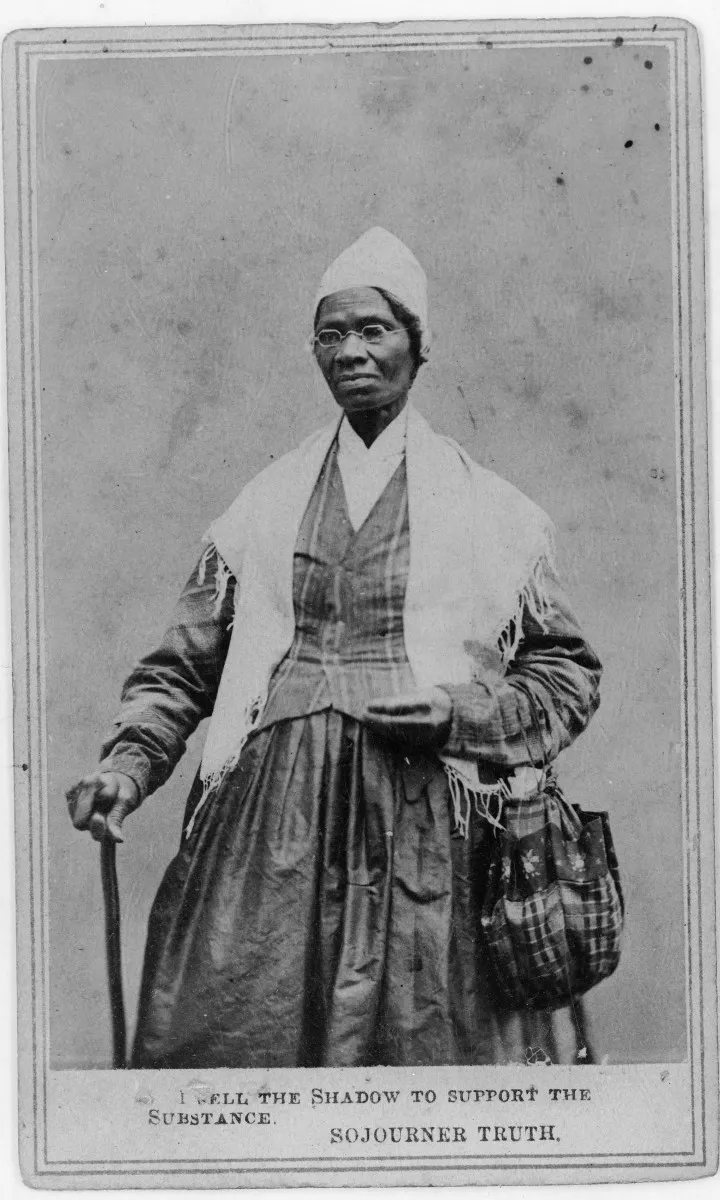
Sojourner Truth, “Ain’t I A Woman?” (1851)
As we think about how race precludes certain groups from participating in the “American Experience,” let us also turn to gender and how, historically, society has treated men and women differently and unequally. To do this we must cast aside our contemporary understanding of gender as fluid and socially constructed to look back through a binary lens, asking ourselves: How did men experience citizenship? And, more importantly, how did women experience citizenship?
Isabella Baumfree was born into slavery in New York in 1797. For the first thirty years of her life she reckoned with the miseries of being sold, beaten and mistreated. Eventually, in response to the New York Anti-Slavery Law of 1827, she ran away from her master. Later, when she experienced a religious conversion in 1843, Baumfree became a travelling preacher and changed her name to Sojourner Truth. As an African American and a woman, she was increasingly involved in the growing antislavery movement, and by the 1850s she was involved in the women’s rights movement as well. Here, the key word is: intersectionality.
In 1851, Truth attended the Women’s Rights Convention in Akron, Ohio. According to several sources, including Frances Gage, the president of the Convention, on the second day several male ministers argued that women should not have the same rights as men. In response to these remarks, Sojourner Truth delivered* one of the most famous abolitionist and women’s rights speeches in American history. Her speech demanded equal human rights for all women as well as for all blacks. By the end of her life in 1883, she had become one of the most powerful advocates for human rights in the 19th century. *She could neither read nor write and the speech was first published 12 years later by Gage in 1863.