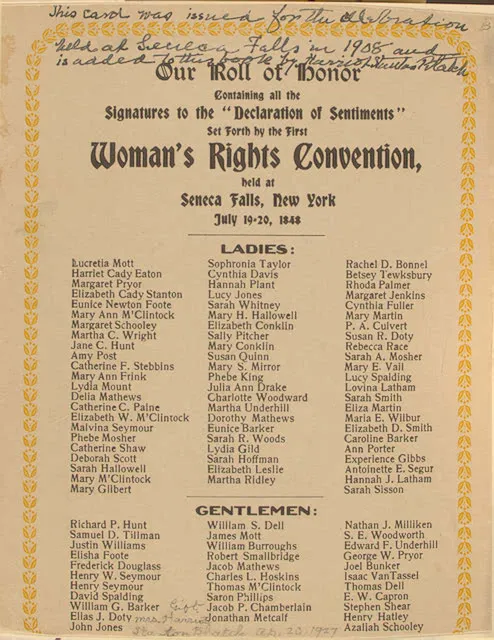
Seneca Falls Conference, “The Declaration of Sentiments” (1848)
The Seneca Falls Convention of 1848 was one of the earliest and most significant meetings of women’s rights activists in America. It was the first convention organized by only women––local Quakers and Elizabeth Cady Stanton, a leading figure of the women’s right movement––and included six sessions about the role of women in society. At the convention, the organizers presented two prepared documents, the Declaration of Sentiments and an accompanying list of resolutions, to be debated and modified before being put forward for signatures.
Despite some opposition from the more conservative visitors, 68 women and 32 men––100 out of 300 attendees–– signed the Declaration of Sentiments, also known as the Declaration of Rights and Sentiments, a document in favor of women’s suffrage. Stanton was the principal author of the Declaration and modelled it on the Declaration of Independence. Notice the similarities (and also differences) between the structure of this document and the Declaration. Interestingly, Frederick Douglass, one of our earlier authors, attended the conference.
As you read the Declaration, who are the “he” and “she” that the document imagines and addresses? What do you think were some of the most contentious parts and resolutions of the document? Why do you think the document in general was so controversial at the time (for instance, why did only 100 attendees sign their names)?