Op Eds on Civic Education
Students Mike A and Dawoud C wrote op eds as a response to their group's research on civic education. Click on the accordion items below to see pictures of the authors and read their essays.
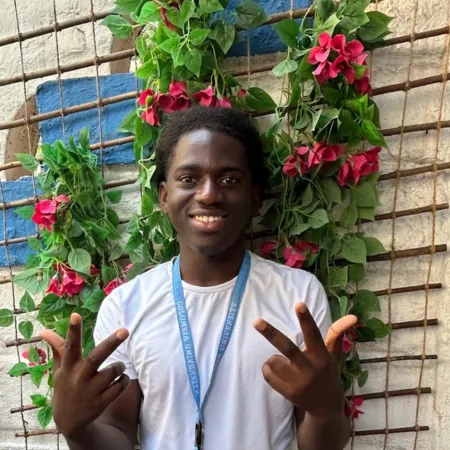

Seated next to high schoolers from across New York City, I explained that forcing TikTok to become an American entity violates the First Amendment, and that the absence of verified evidence of foreign interference makes the case for a forced sale constitutionally weak. However, the opposing side argued with intensity the need to put safety of the people above all, even when it jeopardizes civil liberties. I argued American companies often sell data of citizens to data brokers who then distribute it to foreign nations or people who don't have the best interest of the U.S. in mind.
As enriching as that conversation was, it occurred in a bubble of civically educated and informed teenagers in high school. Everyone was invited by the Union League Club of New York; we didn't know each other yet, but the common denominator amongst all of us was being a participant in a knowledge for freedom program or civic education program. Civic education, at its core, is the practice of equipping citizens with the knowledge, skills, and frameworks to participate meaningfully in the democracy they inhabit. However, as Socrates famously says, "An unexamined life is a life not worth living." The quote seems simple on its surface, but Socrates was not speaking casually. He stood for the supremacy of moral virtue and the care of the soul, the belief that a life without rigorous self-examination and engagement with the world around you is a life half-lived. He was so committed to this that he chose death over silence. When you understand that, the quote stops being a motivational phrase and becomes a civic mandate: equip yourself with the tools to examine your life deeply, and by extension, the society and community around you.
Having gone through Columbia's Freedom and Citizenship program, I know what those tools actually look like when they are set in motion. I sat across fellow high schoolers from all around New York City and found that even in disagreement, we were moving toward something. We were either arriving at a shared truth or leaving with a more developed one. That is what civic education produces, and without it, that room at the Union League Club would have been just another argument going nowhere. So when it comes to discussing civic matters, civic education is not simply important; it is the difference between a conversation that builds and one that destroys.
In the modern day, civic education has been stripped down to knowing the branches of the government, knowing the Star-Spangled Banner and the Pledge of Allegiance. That is widely considered a competent and civically engaged individual. It shouldn't be. I witnessed this firsthand in an AP Seminar when a teacher asked students to identify stakeholders and draft a letter to their community leader for a post-COVID project. The room went silent. Nobody knew what a stakeholder was. Nobody could name who was actively shaping their community. These were not disengaged students; they were simply never given the tools. That silence is what the funding gap sounds like in practice: the federal government invests just five cents per student in civic education compared to roughly $54 per student in STEM, and 13 states have no civics requirement at all. With this level of limited information, you not only lack the mental framework needed to approach civic matters that require nuance and complexity, you also lack the ability of independent thought, which can become dangerous in a democratic society. How so? The majority trumps the minority every single time; that is how our constitution functions, it's by design. As James Madison warned in Federalist No. 10, “When a majority is included in a faction, the form of popular government enables it to sacrifice to its ruling passion or interest, both the public good and the rights of other citizens.” An uninformed majority doesn't just make bad decisions, it makes them confidently, legally, and indifferently. That's the scariest part. History has already shown us what this looks like at its worst. Weimar Germany's democratic elections delivered Adolf Hitler to power in 1933, not through a coup, but through a ballot. An economically devastated and deliberately misinformed majority voted away their own democracy, and by the time they realized what they had done, the mechanisms to undo it were gone.
Without the knowledge for freedom programs or the civic education programs to supplement the gap in our curriculums, the debate about TikTok, national security and amendment rights would not have been as developed and would likely stay shallow. For students at well-resourced schools, these conversations may happen in the classroom. For a student like me, attending a school without the funding to prioritize civic depth, programs like Columbia University's Freedom and Citizenship initiative were the only bridge to that kind of discourse. Every student in that room, regardless of background, arrived through some form of outside civic program; that alone tells you everything about where our curriculums stand. There shouldn't be a reason why we need outside programs to fill a gap that can be fixed with a simple implementation into a pre-existing curriculum.
The night and day comparison between STEM and civics funding is appalling to say the least, but also signals something crucial: systemic neglect. This is not an accident; as the economy shifted toward technology and trade, STEM became the instrument of upward mobility, and civic education, with no job title attached to it, was quietly pushed aside. Civics being low on the priority list means our children are going to grow up and become the same people who judged Socrates in the Apology. Socrates was not killed by a tyrant or a weapon, he was killed by a jury of 500 Athenian citizens who voted, democratically, to end his life. That is what an uninformed majority looks like when it has power and no framework to wield it responsibly. A future like that is not one that I am hopeful for, it's one that I fear for.
Aristotle, reflecting on his research and analysis of 158 disparate Greek city-state constitutions, wrote in his Politics that “No one would dispute, therefore, that legislators should be particularly concerned with the education of the young, since in city-states where this does not occur, the constitutions are harmed. For education should suit the particular constitution” (Book VIII Chapter I). Although this remark was in the context of Aristotle’s 4th-century BC research, the words remain more prevalent than ever today in our civically illiterate, political, and relevant media landscape. However, opportunities presented to first-generation, low-income students across the world, like Columbia’s Freedom and Citizenship program, are working to actively address this issue.
Recently, I have seen firsthand the consequences of this failure in civic education in our society, particularly on X. Rather than offering a diverse range of perspectives, X has morphed into a cesspool of hate and disinformation. Too often, I have seen posts by demagogues with objectively untrue information and judgments gain traction. Due to the platform’s emphasis on virality, X discourages thoughtful and nuanced conversations across the political spectrum. As a result, misinformation, bigotry, and echo chambers are no longer confined to obscure corners of the internet. Instead, they have become a mainstream issue that all users are forced to engage with. This rise in misinformation, not just on X but across relevant media outlets, is not only detrimental to political discourse but also exacerbates existing issues in my community. Living in a low-income, marginalized community, our problems with literacy are already a burden. The ratio for age-appropriate books per child in low-income neighborhoods is one book per 300 children, compared to middle-income areas, where the ratio is 13 books per child. While this represents a broader issue in education, civic education is irrevocably tied to literacy and the lack thereof. The Constitution itself is a work of literature. This is all to say that, unfortunately, my relatives and neighbors do not have the resources to avoid actively voting against their own interests. After all, one in six Americans could not name all three branches of government, with this issue only being worse in marginalized neighborhoods.
Civic education, a backbone of our democracy, is subpar at best in our education system. While it’s useful to have knowledge in many subjects under a liberal arts pedagogical framework, especially reading and writing (as Aristotle further describes), students who graduate are left with little to no understanding of how our government functions. Only 49% of high schoolers report having taken any civics class. Many high school students graduate without learning fundamental concepts, including how our government operates, how to handle misinformation, and even their own rights and freedoms. Simply put, my neighborhood, and many others, do not have the resources to be politically informed, despite the immense benefits it can bring when done correctly.
Yet amid this landscape of civic neglect, there are still pockets of hope where a future of a civically educated society is entirely possible. On March 8th, I participated in the Good Citizens’ Day event, hosted by the Union League Club. There, some 60 high school juniors and seniors received the Good Citizenship Award. During the program, I met and connected with civically educated, motivated students and discussed constitutional issues, ranging from the constitutionality of TikTok’s ban to the 8th Amendment’s cruel and unusual punishment clause in the context of homelessness. Through our taking sides, fruitful debate, and the final persuasive presentations given by each side, one thing was clear: there are clear benefits and advantages when you have the chance to be civically educated. These students were able to engage in fruitful discourse on important constitutional issues with enough vigor to convince opposing perspectives.
The cases being discussed were not abstractions; rather, they were real cases that the courts (and now the students!) wrestled with and came to conclusions about. When debating TikTok's ban, students wrestled with whether national security concerns could ever justify restricting a platform used by 170 million Americans, and whether the government's argument would survive First Amendment scrutiny. When the conversation turned to the 8th Amendment, the question shifted to the rights and limits of the state to introduce a law targeting primarily homeless people. Does leaving a homeless person on a city street constitute cruel and unusual punishment, or does the Constitution simply not reach that far? The kind of civic literacy that develops through these conversations is not simply knowledge of our government. It’s what Aristotle describes in his Nicomachean Ethics as “phronesis”, or the ability to make rational judgements towards the common benefit. Phronesis can’t be learned through simple instruction, but rather lived experience and communal engagement. Students can learn about these cases in classes, but being able to argue a position, defend it, and hear out other perspectives are the methods to actually form this wisdom. It is exactly the citizenship that our constitution—and Aristotle—asks of us.
It’s important to note the context of this event as well. A few others and I had the opportunity to come here through Columbia’s Freedom & Citizenship program. This was not the case for most students there. Most came from well-off families and attended private schools. However, this is exactly the core issue of civic education in our world. Civic education has become somewhat of a privatized luxury--offered in its entirety only to the affluent.
Looking back twenty-four centuries, Aristotle understood that education and a care for the constitution was the foundation of a just society. While these foundations have been cracking, opportunities like Freedom & Citizenship and Good Citizens’ Day prove that foundation can still be buttressed.